Organising a last-minute event: how to make it a success anyway
You’ve known for months: an event needs to happen. But internal decision-making, late approval or simply the pace of the market suddenly leaves you with just a few weeks, and time is running out. The date is fixed, the invitations need to go out, and you’re the one who has to make it happen.
That position may feel uncomfortable, and understandably so. An event that brings together your guests, colleagues or business contacts demands quality. And the thought that you might not be able to deliver that quality simply because you don’t have enough time keeps nagging in the background, even as you’re already writing the invitation.
At InnStyle, we’ve been helping brands such as Rabobank, bol. and Nike deliver events for 30 years, and some of those events come together at short notice. We see what goes well, what goes wrong and, more importantly, what makes the difference between an event that holds its own and one that buckles under pressure. In this article, we’ll walk you through the choices that matter most when your schedule is tight, so you know where to focus your energy and where you’re better off saving it.
Why does a last-minute event fail? Rarely because of time itself
When a last-minute event doesn’t go well, the tendency is to blame time pressure. But what happens more often in practice is that the available time is allocated poorly.
An event manager with four weeks to prepare sometimes spends half that time on things someone else could have arranged: the technical equipment that needs organising, the catering that needs confirming, the guest flow that needs planning, the communication with suppliers that needs handling. None of those hours go towards the content. And the content is precisely where you are truly indispensable.
Organising the logistics should not be so time-consuming that they get in the way of your objective. It’s something we see time and again at InnStyle: events that turn out well despite time pressure are almost always those where the organiser decided early on to entrust the practical delivery to someone else.

Which venue should you choose when time is tight?
When you have plenty of lead time for an event, you can choose a venue that offers a blank canvas and shape it step by step as you prepare. An old factory, a former church, an industrial hall: beautiful spaces, but spaces that still ask something of you. Their emptiness needs filling, and that takes time. Time to create the atmosphere, plan the guest flow, furnish the space, add the branding and arrange the catering. Everything a full-service venue already provides has to be put in place by you.
With one month to prepare, that’s a risk you’d ideally avoid.
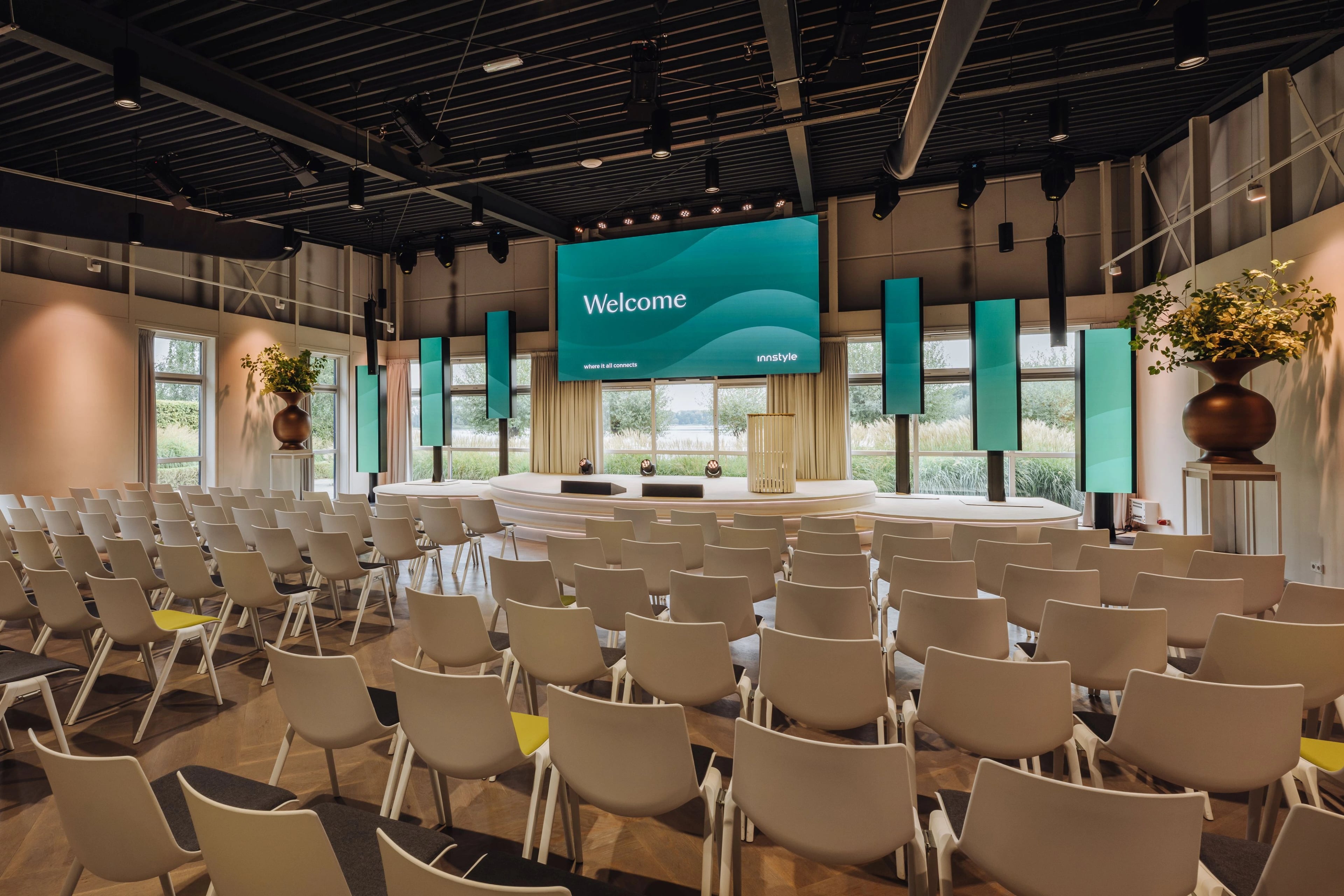
A marketing manager who recently organised a product launch with us for almost a hundred people visited several event venues in Utrecht in one day. She faced exactly that choice: impressive industrial spaces on the one hand, and InnStyle on the other. She walked up the driveway, saw the presentation space with its plant wall, green lighting and view, and knew straight away.
'If I’d done this at a venue that was a black box, where I’d have had to put everything in place myself, it simply wouldn’t have been possible in such a short time.'
What she was looking for was a venue that already worked. One that didn’t force her to create the atmosphere, interior design and logistics herself too, and that also fitted the story she wanted to tell.
The difference between a venue that already works and a blank canvas
A venue that already has a character that aligns with your brand or message gives you room to refine. You add, you highlight, you personalise. With a blank canvas, you start from zero, and zero always takes more time than you think. And of course, a blank canvas can sometimes be the right choice too, for example when you have boundless creativity and both the time and the people to create everything entirely yourself.
By choosing a venue that was already the right fit for the event, the marketing manager could focus her attention on the programme itself. On what she actually wanted her guests to take away, what story she wanted to tell and how to make sure the content stayed with them afterwards. Exactly the kind of work that only she could do, and that makes you indispensable as an event manager too. You’d rather leave the rest to someone else.
What a full-service venue does for you in practice
At InnStyle, ‘full service’ means we help you think through the programme from the very first briefing. Not just which spaces you need, but also how your guests move through the day, how the technical equipment works, where the food and drink will be and what could go wrong logistically before it even occurs to you.
At many other venues, you hire a space and arrange everything else yourself: sound, presentation equipment, catering, room layout, all separate suppliers you manage yourself. If one link in the chain fails, you step in.
The marketing manager who organised her launch with us was still making changes to her presentation the evening before the event. The next morning, she sent over the final version. The event ran flawlessly.

How do you approach a last-minute event when the date is almost set?
Choosing the right venue gets you a long way, but there’s still plenty to do. What we see at InnStyle is that event managers who perform well under time pressure don’t start with a detailed project plan. They start with the objective of the day itself and work backwards.
Step 1: start with the day itself and work backwards
What needs to be in place on the day of the event? What needs to be ready a week beforehand? When do the invitations need to go out so guests can still save the date? A simple timeline on a single A4 sheet gives you a clearer overview than a detailed running order that takes a long time to put together. You can leave that running order to your venue.
Step 2: decide early what you will do yourself and what you will leave to the venue
The more clearly you make that distinction, the more time you have for what is truly your responsibility. A venue can take care of guest flow, technical support and catering. No one else can decide for you what story you want your guests to take away.
Step 3: focus on the story, not the logistics
Guests do not travel from all over the country just for an information session. They come for something that resonates with them: where have you come from, what have you learnt, where are you heading? An honest story about your journey always works better than a polished presentation of your achievements. And when you connect with people, your message stays with them.
Step 4: leave room for the unexpected
Not as a buffer for procrastination, but because last-minute events simply tend to involve more last-minute changes. Anyone whose schedule is planned down to the minute will spend the day putting out fires rather than looking after their guests.
When is one month enough?
One month of preparation is achievable for a medium-sized event at a full-service venue that takes care of the practical work. It is tight if you also have to coordinate the logistics, technical support and catering yourself. And it is probably unrealistic if the content of the programme is still completely undecided.
The marketing manager we mentioned earlier organised her event in one month. But afterwards, she honestly admitted that three months would have been much less stressful. That also leaves room for potential setbacks, because however much we want to plan everything perfectly, sometimes things do not work out straight away.
The rule of thumb we use at InnStyle: the less you need to organise yourself on the day, the less lead time you need overall. That is not a biased recommendation to outsource, but a practical observation we see time and again.
.jpg)
Summer events and last-minute planning: diaries fill up faster than you think
For many companies, summer is the ideal season for an event to connect with business contacts, mark the end of the first half of the year or enjoy an informal day with the team. Not the usual end-of-season drinks, but a summer occasion where everyone can truly switch off from their day-to-day work. That wish is understandable, but the timing can catch you out: before you know it, diaries are full and everyone is on holiday.
At InnStyle, we offer a summer package in juli and augustus for groups of twenty or more, with a set programme that lets you enjoy five hours by the Maarsseveense Plassen.
You don't have to worry about a thing. We take care of every detail of the programme, so you can be among your guests rather than behind the scenes with the running order in hand.
If you know you want to organise something in July or August, now is the time to act. For more information about summer at InnStyle, click here.
Checklist: the essentials you need in place for a last-minute event
Venue and logistics
Content and communication
On the day
A successful event has more to do with decisions than lead time
Having read this article, you'll know that most last-minute events don't fail because of a lack of time, but because decisions are made too late or in too fragmented a way. The marketing manager who organised her launch with us in one month spent the event day among a hundred guests who had no idea of the time pressure under which everything had come together.
Our advice is therefore: choose a venue that already has the right look and feel, put the logistics in the hands of a team that has done it before and focus your own attention on the story you want to tell. Regardless of your lead time, those three decisions make the biggest difference between an organiser who is still stressed on the day and an event manager who is centre stage and proud of what has been achieved.
At InnStyle, we've been supporting clients who want to create an event that makes a real impression for 30 years. We take care of the practicalities, offer ideas wherever we can and make sure that, on the day, you can be the host everyone is delighted with.
Request a proposal or take a look at our summer package for a complete event in July and August by the Maarsseveense Plassen. We're happy to help you explore your options, even if the date is closer than you'd like – this is a dynamic, fast-paced industry, after all, and that's certainly part of its charm.
And would you like to read more about organising a business event? We previously wrote about event preparation and how you can approach it.