Autumn event venue: conference hall, outdoors or indoors/outdoors?
Which venue should you choose for your autumn event? And how do you know whether that choice meets your needs and those of your guests on the day?
As an event manager or office manager, you want to create something that leaves a lasting impression. But autumn brings uncertainties that do not come into play in summer: bad weather, dark days and groups already running on empty because of their workload. It is tempting to choose what feels safe. A conference hall, easy to reach and always dry. But is that also the choice that will help your message resonate most effectively?
I’m Nancy (account manager), and just recently I heard a client say they would rather play it safe with a conference hall for an autumn event. But over my past three years at InnStyle, I have seen time and again how important atmosphere and fresh air are, even in autumn and winter.
After reading this article, you will be able to make a considered, informed choice of venue for your autumn event, based on the criteria that really matter.
In this article, we compare:
- The three most common venue types for autumn business events
- How they compare in terms of weather, daylight, atmosphere and event objectives
- When a conference hall is the right choice
- The most common mistakes when choosing an autumn venue
- A practical checklist to help you weigh up the options
What makes choosing a venue in autumn different?
In summer, you choose a venue with different expectations from those you have in autumn. The conditions are different, your attendees’ energy levels are different and the objectives are different.
While summer events often revolve around connection, relaxation and team fun, autumn events tend to focus more on reflection, focus and preparation for the new year. Think of looking back on the past year, communicating a strategic message or helping teams reconnect after a busy period.
On top of that, the weather plays a role that matters less in summer. In October and November, you may arrive in the dark, see little daylight during the day and, if it rains, a poorly chosen venue immediately feels much worse.
'The venue you choose directly influences the energy in the room. And that energy determines whether your message resonates or not.'

The three venue types at a glance
Before we compare them, it helps to be clear about which venue types we mean. After all, ‘finding a venue’ sounds simple, but there are major differences in what each type has to offer you and your guests.
The traditional conference hall
These are large, functional event venues designed primarily around capacity and logistics. Think of the Jaarbeurs in Utrecht, the RAI in Amsterdam or the World Forum in Den Haag. They are easy to reach, equipped with technical facilities and able to accommodate hundreds, sometimes thousands of guests.
The outdoor venue
A venue where the event takes place mostly outdoors . Fantastic in summer, but vulnerable in autumn. Think of marquees on a country estate, a beach event or another open site. Without good covered facilities, this type of venue is a risk in autumn.
The indoor/outdoor venue
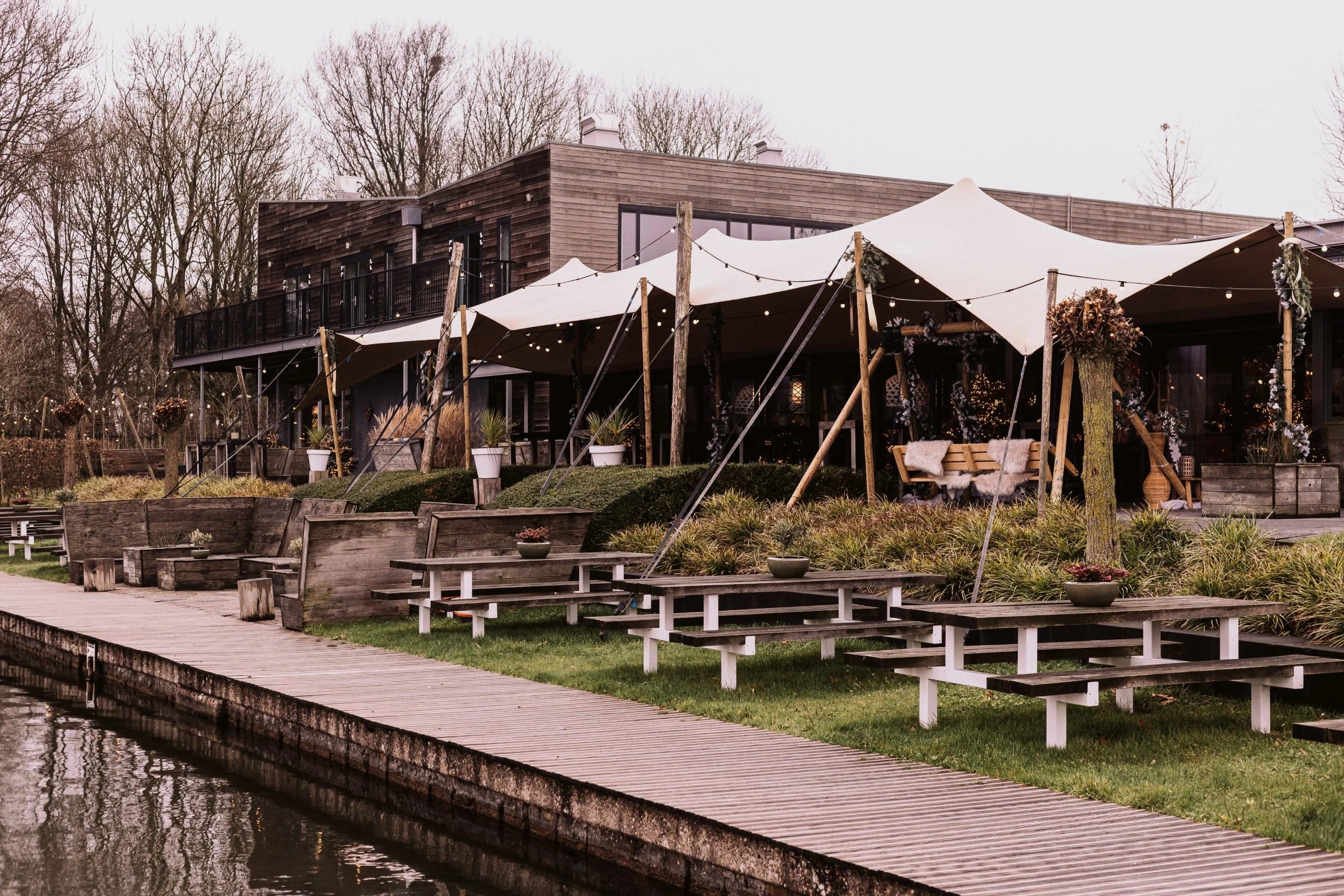
This type combines the best of both worlds. You have the technical facilities and shelter of an indoor space, as well as direct access to outdoor space, daylight and green surroundings. InnStyle is an example of this: it can be used entirely under cover, while still offering views of and access to the outdoor space.
The three venue types at a glance
Choosing a venue starts with an honest comparison. Below, you can see how the three venue types compare against the criteria that make a difference to your autumn event.
Conference hall | Outdoor venue | Indoor/outdoor venue | |
Weather & reliability | Always dry | Risk when it rains | Plan B possible |
Daylight | Often no windows | Plenty of daylight | Daylight and views |
Atmosphere & experience | Functional, impersonal | Unique and memorable | Atmosphere whatever the weather |
Connection | Limited | Strong | Strong |
Focus | Moderate | Weather-dependent | Optimal |
Inspiration | Little stimulation | Strong in good conditions | Always present |
Performance & activation | Little room to move | Plenty of possibilities | Indoors and outdoors |
Large groups (500+) | Suitable | Depends on the venue | Limited |
Suitable for autumn | Functional, but dull | Risky | Suitable |
A comparison based on the criteria that really matter
Point 1: weather and reliability
In autumn, this is often the first concern. And rightly so, because nobody wants to cancel an event or improvise because of a passing downpour.
A conference hall scores highly for reliability here. You are entirely indoors, the weather has no bearing and there is always a roof over your head. That gives you peace of mind when planning.
A purely outdoor venue is risky in autumn. Even with a marquee, you depend on the temperature, wind and rainfall. Outdoor activities are cancelled or scaled back, and that affects the atmosphere.
An indoor/outdoor venue offers a smart balance. At InnStyle, we always have solutions for weather risks. Heaters, ponchos, a marquee by the barbecue.
If something really cannot take place outdoors, we move it indoors without compromising the atmosphere. The view is always there, even when it rains.
Want to know more about managing weather risks at a corporate event? Also read: how to manage weather risks on a company outing.
Point 2: daylight and energy
This is the most underestimated criterion, yet it has the greatest influence on how your guests feel at the end of the day.
In a conference hall, you see a recurring pattern: participants arrive in the dark, sit indoors all day and leave when it is dark again. Not a moment of daylight. That sounds exaggerated, but in autumn and winter it is simply the reality, and it affects people. Energy and inspiration drop when people have to sit through plenary sessions all day in a room without windows.
At an indoor/outdoor venue, natural light is a given. Views of greenery, water and an open horizon.
'That may seem like a detail, but it is the difference between ending the day full of energy and coming home exhausted.'
Point 3: atmosphere and experience
A conference hall is primarily functional and efficient. For many events, that is perfectly fine. But if you want your guests to keep talking about it for weeks afterwards, you need more than a good plenary space.
I see our guests respond to the water straight away. When they arrive here, guests often head straight outside. We then hear: what a beautiful view, what a peaceful setting. One of our clients said, in those exact words: ‘what a gift to be able to work here every day.’
An outdoor venue scores well on atmosphere, but in autumn it is too dependent on the conditions. An overcast, rainy day quickly takes away the magic.
An indoor/outdoor venue offers an atmosphere that does not depend on the weather. The setting always works, whether it is 25 degrees or a grey autumn day with gusts of wind.

Suitability for each event objective
Ultimately, this is at the heart of the decision. After all, the venue is not the goal; your event is.
Objective 1: connection calls for an environment that encourages people to open up. Space, natural light and an informal setting help spark conversations that would not otherwise happen. A conference hall confines people to theatre-style seating, but could encourage interaction during an informal drinks reception. An indoor/outdoor venue invites interaction throughout the programme.
Objective 2: focus calls for an environment without distractions, but also without the oppressive feeling of a dark room. Natural light and views actually help people stay sharp and maintain their energy.
Objective 3: inspiration is almost impossible to separate from the surroundings. You can have the best speaker, but if the room overlooks an industrial estate or a car park, half the battle is already lost. If it is dark and gloomy outside and you also choose a dark venue, the overall experience will not be inspiring. If, however, you choose to fully style a conference hall with technology, branding and stands, you already create a much more dynamic experience.
Objective 4: performance calls for people to be energised, physically and mentally. That is harder to achieve in a conference hall where the only change of scene is a coffee break in the corridor. An indoor/outdoor venue offers space for activities that literally get people moving. An outdoor venue naturally does this even more effectively – although the caveat is that the autumn weather does not always make this a practical option.
When is a conference hall the right choice?
An honest comparison also means acknowledging when a conference hall is the best option, because sometimes it certainly is.
For very large groups, from around 500 to 1000 people in a plenary session, a conference hall is often the only feasible option. A medium-sized indoor/outdoor venue simply cannot always accommodate that.
If your event is entirely focused on a polished plenary presentation for a large, anonymous audience, with atmosphere and experience playing a smaller role, a conference hall may also suffice. Think of a large trade fair or a public conference where capacity and accessibility matter more than the experience.
But for most corporate team days, strategy sessions, knowledge-sharing days and year-end events where the message really needs to sink in and people really need to be inspired to act, a conference hall is rarely the best choice – even if it may be the obvious one.
Common mistakes when choosing an autumn venue
Mistake 1: choosing the venue out of habit. Last year you went to the Jaarbeurs, so you might as well go there again this year. Understandable, but rarely the most considered choice.
Mistake 2: forgetting the objective when choosing the venue. The venue is only chosen late in the process, even though it is the foundation for everything that follows.
Mistake 3: letting the risk of bad weather outweigh the experience. Bad weather is a real risk in autumn, but that is no reason to automatically choose an event without outdoor space. Good venues always have a plan B. Read here how we deal with the risk of bad weather.
Mistake 4: forgetting that daylight determines energy levels. This is almost always underestimated. No programme can make up for a day without light and fresh air.
-1.jpg)
Checklist: how to choose the right venue for your autumn event
Use this checklist when considering a venue in autumn:
Would you also like to know how to choose the right event venue? Then read: how to choose the right team-building venue, about weighing up a city venue against one in nature.
How to give your event the space it deserves
Now that you know the real differences between a conference hall, an outdoor venue and an indoor/outdoor venue, you can make a choice that suits your objective. For most corporate events where the message, energy and experience take centre stage, an indoor/outdoor venue offers the most scope to make an impact.
You are organising this event because you want to achieve something. Because the message needs to sink in, the team needs to reconnect, or the year needs to end on the right note. A venue that works against that makes things harder before the day has even begun.
At InnStyle, we have been organising events for clients such as Rabobank, bol. and Nike for 30 years. We know what it takes to make a day a success, even when the weather is against us.
Request a no-obligation proposal through our website today, or arrange a venue visit and experience for yourself what makes the difference.
where it all connects

Nancy
Event advisor
''Behind every successful event is a strong planning process.'' My background in hospitality has taught me what being hospitable means in practice. At InnStyle, I combine that with the variety the role offers and working with a strong team. My favourite events are business gatherings with carefully planned catering, a walking dinner or a served dinner. An event is remembered for its content, but also for the moments around it, and food & drinks play a leading role in that.