Booking a business event venue in autumn: what to consider before you choose
From September onwards, my phone rings off the hook. Many event managers have just secured their budget and approval, and want to book a business event venue within a few weeks before everyone's diaries fill up again.
They have usually already looked at a shortlist of options, but are still unsure: do they choose the safe option of a conference hall they have used before, or dare to try something different this time? And above all: how do they avoid regretting a decision made under time pressure a few months down the line?
I'm Tanja, commercial coordinator at InnStyle. I have these conversations with event managers who are often not yet very familiar with InnStyle, and in autumn I sometimes have them three times a day. Every year, I hear the same questions and see the same pitfall: people compare venues on the wrong criteria.
In this article, I explain what I ask event managers before we put together a proposal, and why those questions tell you more about the outcome of your event than the photos on a website. At the end of this article, you'll find a checklist you can use on every venue visit for your autumn event.
''You decide whether guests go home recharged or exhausted, and that starts with a conversation you have before choosing your venue.''
Why business event venues fill up faster than you expect in autumn
September, October and November are effectively a second peak season for business event venues, alongside May and June. Companies that still need to spend their annual budget, teams that have postponed an event originally planned for the summer, and organisations that want to kick off Q4 with a day together: they all converge on the same ten weeks. I'm now even receiving enquiries for 2027, simply because event managers know autumn is busy and would rather book early than regret it later.
So don't wait until your programme is fully finalised before securing a venue and date. You can still fine-tune the details of your day later. The date and venue are the two things most likely to be snapped up by another client, and they are precisely the things you should arrange first.
.webp)
The conversation that comes before booking a business event venue
When an event manager calls me, I rarely start by discussing capacity or price. The first question I ask is: what do you want the evaluation to say? Do you want your product to sell, do you want guests to be informed, do you want to inspire them, or simply thank them for a good year? That answer determines which venue and programme make sense, and tells you much more than the number of square metres.
Your objective also says something about the atmosphere that suits you. A corporate organisation that has traditionally come across as a little stuffy and businesslike is not suddenly going to opt for a programme packed with stunts, and there is no need for it to do so. The venue can be calm and well presented, with good coffee and convenient parking right outside, without needing a slide or a bungee tower. If you do want to add something playful, a small gesture is often a better fit than making it part of the venue itself.
''You only get one chance to make a first impression, and it is formed within seven seconds. You shape how your guests experience the day before a single speaker steps onto the stage.''
Why autumn weather is no reason to rule out outdoor space
In autumn, I often see event managers automatically choosing an enclosed conference hall for fear of rain or cold. That instinct is understandable, but it is not a compelling reason to dismiss a venue with outdoor space straight away.
At InnStyle, activities still go ahead, even on a grey day, unless there is an orange or red weather warning for thunderstorms. We always have umbrellas to hand, and almost everyone can manage a short walk in the rain wearing a poncho.
A walk outdoors like this, even on a dreary Thursday in November, can be just the breathing space a packed programme needs. So ask every venue you are considering specifically about the bad-weather plan, rather than writing off the outdoor space straight away.
At InnStyle, we call this an indoor/outdoor venue: you can use it entirely under cover, with direct access to outdoor space and daylight as soon as the weather allows. Would you like a detailed comparison of a conference hall, a purely outdoor venue and an indoor/outdoor venue? You can find it in our article on choosing an event venue in autumn.

Why daylight matters more than a tightly planned programme
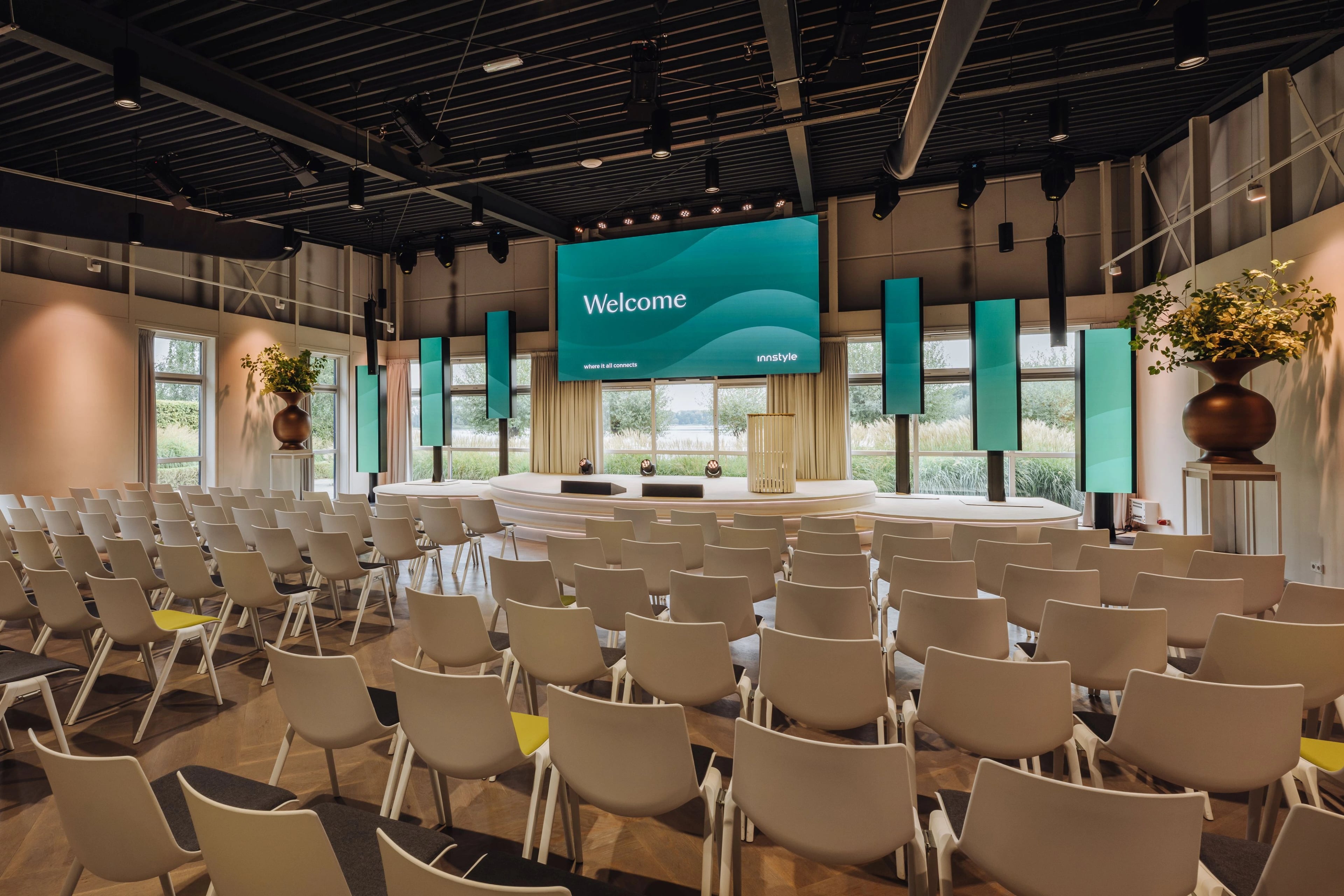
The space where your event takes place has more influence on your guests' mood than the programme itself. I once attended a communications conference where the meeting room felt completely cut off from the outside: no windows, no view, all day long. By the end of the day, nobody had any sense of time left, and you could see it in how tired and distracted everyone was.
Daylight is one of the most underestimated factors when choosing a venue in autumn. I also sometimes visit venues where the curtains are kept closed as standard, simply to make a screen easy to read. That works for the presentation, but it drains the energy from the room throughout the day. On a bright day in June, you might not notice the difference straight away, but on a grey day in November, a windowless room starts to feel like evening by eleven in the morning.
Mysolution, one of our regular clients, deliberately chooses a 360-degree layout rather than a traditional theatre-style layout for its annual customer day. In a theatre-style layout, energy levels drop, while people sitting in a circle stay more alert and find it easier to talk to each other. To see what that looks like in practice, read the Mysolution customer day case study.
What you feel during a venue visit, but never see on a website
A brochure or website shows you the spaces, but not how they feel. How you are welcomed when you arrive, how sound carries in a room, whether it gets stuffy after half an hour: you only know once you are actually there.
My advice to every event manager: always visit a venue yourself before you book, even if the photos have already won you over. If it does not feel right during that visit, keep looking. If it does, you will usually know within a few minutes.

Checklist: ask these questions when booking a business event venue
Use these points on every venue visit, and ask yourself these questions as well as the venue team:
From uncertainty about venues to confidence in your choice
Now that you know what to look for when choosing a business event venue, the process is simpler than you expected. It is about matching the atmosphere, light and flexibility to what you want to achieve with your guests, rather than choosing the largest space or the best photos.
I understand that the pressure to make a quick decision during this hectic period is considerable, and that there seems to be little time to consider everything calmly. At InnStyle, this is exactly when we help you: from the very first phone call, we work with you to explore what your event needs to achieve, and translate that into a venue and programme that fit. We have been doing this for 30 years for organisations such as Rabobank, bol. and Nike.
Once the event venue is confirmed, the rest of the programme often still needs planning. Our colleague Amber has written a practical checklist for organising a knowledge-sharing day in autumn, which is useful if, after choosing the venue, you still need to plan the rest of the day.
Request a proposal and tell me a little about the purpose of your event, and I will work with you from that very first conversation. Your autumn event does not have to be an extra source of stress. With the right preparation, you can make sure your guests go home feeling recharged.

Tanja
Commercial Coordinator
"Hospitality starts with you." I have a broad background in hospitality: from working on the restaurant floor to roles as a sommelier, host and account manager. At InnStyle, I bring all that experience together throughout the sales process, from the first contact to an event that perfectly reflects what a client wants to convey. My favourite events are client events, where you work with the client to look after their guests and help shape what you want them to take away. The best moment is making that connection with a client who gets excited about your ideas.