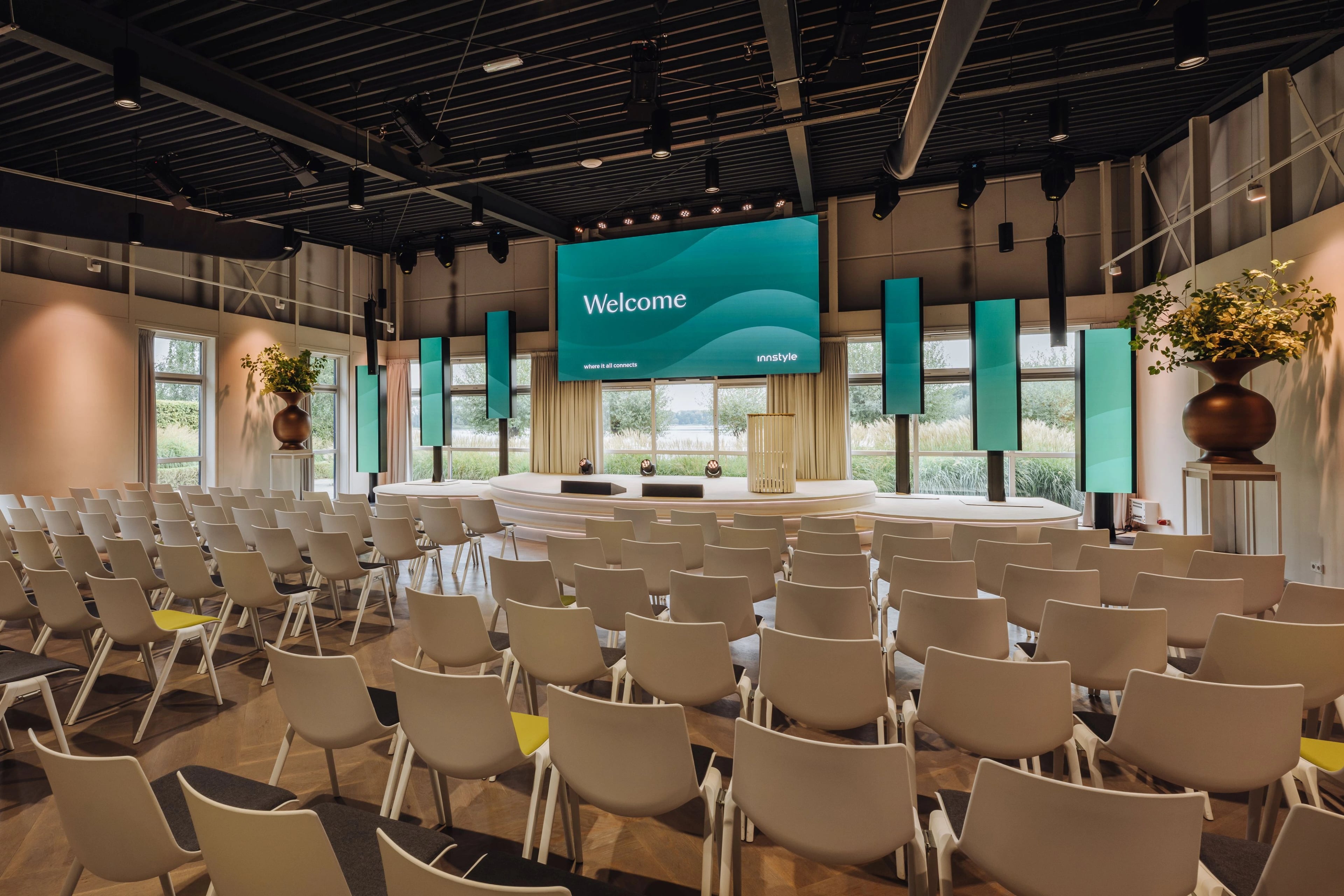
50 events & 7.000 guests: what you learn about organising business events during peak season
Event managers can breathe again and relax their shoulders: the peak season for business events is over. Here at InnStyle, we were fully booked right up to the first week of July, with dozens of events, thousands of guests and regularly three to four events taking place under the same roof at once. Now that the dust has settled, it is time to look back. And above all, to share what we have learnt.
Because if you are planning a business event during peak season, you might be wondering: will my event get the attention it deserves, or will I have to share the day with three other clients who expect the same? It is a fair question, and one we asked ourselves as a team every single day.
I’m Tommie, operations manager at InnStyle. In this review, I’ll walk you through how we approached this peak season, the challenges we faced and what we learnt from them. That way, as an event manager, you’ll know exactly what to look out for when organising a business event during the busiest time of the year.
Organising business events during peak season: what June looked like at InnStyle
Almost 50 events in a month and a half, three times as busy as usual
The peak season ran from late May to early July, and we hosted almost 50 events with more than 7.000 invited guests in total during that period. For us, organising events during peak season mainly means doing the same work in much less time.
The remarkable thing is that it does not feel ten times as busy, even though it sometimes looks that way. Our preparation was solid: the schedule worked and we had the right staffing levels, so despite the long days, it all remained manageable. That is why we start preparing months in advance.

The biggest challenge: changes in the weather and suppliers
There were some challenges too. We had to contend with tropical weather: an approaching storm that meant we had to adapt in no time, and heat that brought its own challenges, such as hiring extra air conditioning units at the last minute and adding more water stations.
What we learnt most from was coordinating with suppliers. During a busy period, different teams can sometimes get in each other’s way, and minor ambiguities that would not be a problem in a quiet month become more noticeable.
''The booking is with InnStyle, not with a supplier. So if something goes wrong, we resolve it, not the supplier. That is the key lesson: we need to make that even clearer next year.''
Our conclusion: we need to make our expectations even clearer to our partners, and do so during the planning stage, not only when something goes wrong. As I always tell my team: we are responsible, even if a third party falls short.
At the same time, we would be nowhere without our suppliers. They are an indispensable part of every event we run, and they have worked incredibly hard during this peak season too, helping us make the most of it together. Collaboration is an ongoing process, and precisely because we need each other, we keep investing in that relationship. This way, we learn together about what both parties need and are even better prepared for the next event.
The highlight: running four to five events in one day
My personal highlight of this peak season is that on some days we ran four to five events at the same time, and were able to respond increasingly quickly whenever something went wrong. If a delivery did not arrive on time, we collected it ourselves. If something went wrong on the floor, the team sorted it out down to the last detail, without the client noticing a thing.
''Ultimately, the real masterwork always comes down to the event directors. They are on the floor and have to get every aspect of the event right, from A to Z. Our hospitality staff have really rolled up their sleeves too. The team's work ethic over the past few months is something I am truly proud of.''
Because that is what matters most: a client is not concerned with how busy we are. They simply want their event to run well, and rightly so. Whether there are four other events or none at all.
I am genuinely proud that we have managed to deliver every time, despite sometimes having as many as four different events on the same day, and especially proud of the team who are on the floor day in, day out, doing the work.

Tips for organising business events during peak season
Tip 1: keep it short and playful - less plenary time, more focus on activities
What I would like event managers to take on board for the summer: keep the plenary programme short and focused, and create a playful setting around it. After a busy six months, this is the perfect time to get your team moving, quite literally. Think of an activity, good food, drinks and perhaps a barbecue. People want to see each other in a different light, let go of stress and simply have fun before everyone heads off on their summer holidays.
Tip 2: book in good time and communicate your requirements early and clearly
This may seem obvious, but it really makes a difference: the earlier you tell us what you need, the better we can prepare. Tell us not just how many guests you expect, but also what kind of company you are, who your audience is and what your objective is. The more we know, the more tailored our advice can be and the more relaxed you will feel on the day of the event, because you can confidently leave us in charge.
Tip 3: avoid last-minute programme changes
An extra half-hour, an adjusted schedule, an additional request that suddenly comes up: outside peak season, we can accommodate these changes more easily. During a busy period, things are different. Many arrangements have already been confirmed and prepared, and a change two days beforehand may simply no longer be feasible for the staff or caterer. Our tip: as soon as you know something needs to change, let us know straight away, because waiting until the last minute makes things more challenging for everyone.

No-shows at your business event: what they cost and how to reduce them
The impact on planning, catering and costs
At the time of writing, we do not yet know exactly how many of the more than 7.000 people invited during peak season actually attended, but no-shows are an issue that deserves more attention regardless. A no-show rate of around 10% is normal and does not surprise us. But if half the guests suddenly fail to turn up, you are left with more staff than you need, with no way to adjust staffing levels, and a lot of food waste – such a shame.
The outcome is often just as unfavourable for the client: the same amount of money has been spent, but half the guests are missing. It is a loss for both sides that is largely avoidable.
''If a client says: we want 200 people here, then we plan for those 200 people to come, not half of them. In terms of staffing, we are simply at full strength when we need to be.''
Practical tips to reduce no-shows
What helps: make the registration process as simple and digital as possible, so that checking in is quicker too. Send a reminder or push notification beforehand, and highlight in the invitation why attending is worthwhile, so the client can also present it as something valuable to their own staff or guests. Helping guests recognise that value often makes more of a difference than you might think.
What InnStyle will be paying closer attention to
Focus area 1: managing expectations more effectively with suppliers and staff
The biggest internal lesson from this peak season is about managing expectations: finding out exactly what a client needs, and communicating that information even more clearly to our partners and staff. The more specific we are, the better the delivery matches what the client had in mind.
Focus area 2: specific advice based on your audience and programme
Something else we want to do more consistently: proactively offer advice based on what we know. If you hear that a group includes people with big appetites, for example, you would recommend a different menu than you would for a group who prefer light, healthy food. By communicating requirements earlier and more specifically, we can avoid surprises on the day itself, even when it is busy and hot.

InnStyle in numbers: peak season at a glance
A look behind the scenes during peak season:
- 21 barbecues catered for, nearly half of all events
- Around 6.000 burgers served, with noticeably greater demand for salads and salmon due to the heat
- More than half of the events included an activity or team-building element
- Golf driving (18x), Team Spirit Games (9x), dragon boating (6x) and archery (5x) as the most popular activities
How clients rated us
Evaluation forms were completed after 8 events. These are the average scores:
- Overall experience: 8,4
- Atmosphere and appearance: 9,0
- Service and support from the event director: 8,8
- Catering: 8,0
- Preparation, planning and communication beforehand: 8,6
- Recommendation score: 8,6
Most requested spaces
These were the four most booked spaces of the peak season:
.webp)
Successes to celebrate
Compliments from clients
The best compliment we can receive lies in what happens afterwards: a client who books their next event the very next day. That happened several times this peak season, and as far as we’re concerned, it says more than a thousand words.
''Giving a compliment is often harder than raising a complaint. But the biggest compliment is: we’d love to come back, we’ve had a fantastic day, and then the very next day, the next event is already booked.''
Returning clients as a sign of trust
We see regular partners such as Rabobank and BAM return season after season, precisely because they know they’re in good hands with us, even during busy periods. This peak season, we also received specific compliments about working with our staff, because guests felt at ease and could leave everything to us. At a time when good hospitality staff are hard to find, that may well be the compliment I’m most proud of.
Ready for the next peak season
This summer peak season shows what makes a successful business event: the preparation, the collaboration and the people who make sure everything runs smoothly, even when it’s busy. After nearly 50 events, more than 7.000 guests and a whole host of lessons learnt, we know exactly what we at InnStyle need to pay even closer attention to, and what you as an event manager can do to make your own event run even more smoothly.
Whether you’re planning summer team building, a large autumn event, or something in between: the sooner you share your wishes, the better we can prepare, and the more peace of mind you’ll have on the day itself. We’re here for you, in every season, with the same attention to detail that made this peak season possible once again.
Want to know what InnStyle can do for your next event? Request a proposal and tell us a little about your target audience and objectives straight away, so we can help you develop your ideas from the very first phone call.

Tommie
Teamlead Event Operations
"Good preparation is 75% of the work." I’ve worked in hospitality and events throughout my career. At the Johan Cruijff ArenA, I gained extensive experience in the events sector, particularly in organising large sporting events and music festivals. Organising high-end events for Ron Gastrobar further sharpened my eye for detail and my ability to deliver to a high standard. At InnStyle, I lead the event managers, hospitality support team and flexible hospitality staff, with a daily focus on service quality across the board. My favourite event is a seated dinner: it brings together every aspect of hospitality, requires the most preparation and always adds a little extra flair to an event. Knowing that guests go home feeling fantastic at the end of the day is what makes it all worthwhile for me.